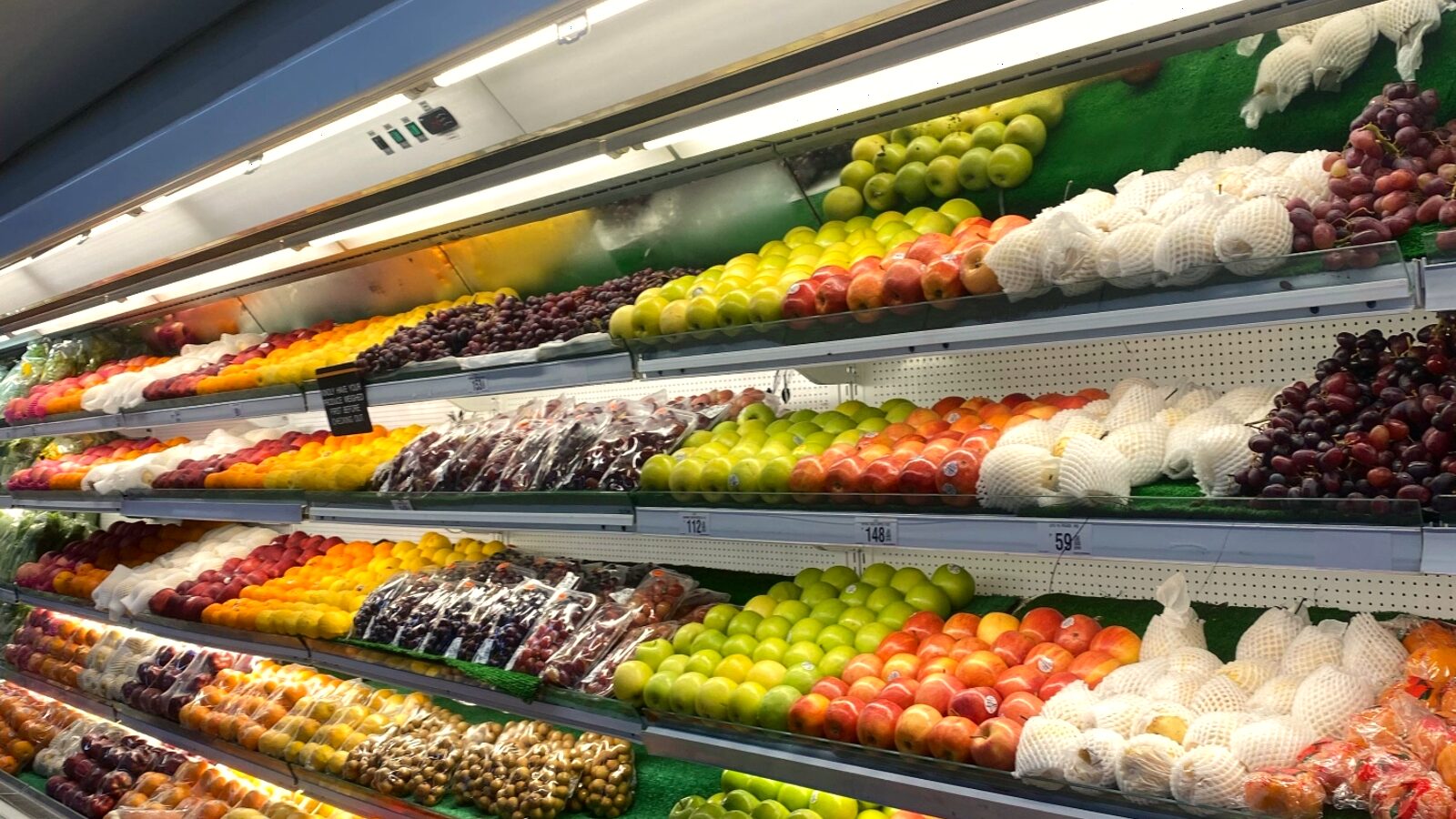
Imagine walking into a Kaufland in Bucharest. On the shelf, a kilogram of Romanian tomatoes costs 9.90 lei (about €2). You pay it, you go home. What you do not see is the journey that price tag has just taken, how the number was assembled, who took which slice of it, and why the farmer who actually grew those tomatoes received less than 1.40 lei (€0.28) for them.
This question, who profits from food, is one of the most thoroughly documented in the EU, and paradoxically one of the least discussed in Romania. For more than a decade, the European Commission's Food Chain Observatory has tracked how every euro spent on food is split. The conclusion repeats year after year: the farmer takes the smallest slice. And for unprocessed products (vegetables, fruit, eggs) the imbalance is sharper than in any other sector.
Anatomy of a 9.90 lei tomato
Using European Commission data on margins along the fruit and vegetable chain, we can reconstruct exactly where the 9.90 lei goes. The numbers below are the average for unprocessed produce sold through modern retail in Central and Eastern Europe.
| Stage | Captured | Share of price |
|---|---|---|
| Farmer (farm-gate price) | 1.38 lei | 13.9% |
| Local aggregator / collector | 0.89 lei | 9.0% |
| Transport & cold storage | 0.76 lei | 7.7% |
| Packaging & labelling | 0.52 lei | 5.3% |
| Distributor / wholesaler | 1.15 lei | 11.6% |
| Retailer margin | 3.76 lei | 38.0% |
| VAT (9% on food) | 0.82 lei | 8.3% |
| Shrink & shelf adjustments | 0.62 lei | 6.2% |
Two things stand out. First: the farmer earns less than the retailer takes purely as shelf margin. Second: nearly a quarter of the price is absorbed by operations (transport, packing, distribution) that a short chain can shrink dramatically or eliminate.
This is not a hypothetical scenario. In May 2024, a family of vegetable growers from Matca, Galați county, showed publicly that they sell cucumbers at 1 leu per kilogram, while the same product was selling at 7 lei per kilogram in a major retail chain. Other producers confirmed prices of 70–80 bani per kilogram at the time. The farmer kept 14% of the shelf price.
Why the farmer always loses
The farmer's weakness in this equation is not accidental. It is the product of three structural imbalances that deepen every year.
- Retail concentration. Per GfK 2023 data, Romania's top 5 retailers (Kaufland, Lidl, Carrefour, Profi, Auchan) control over 65% of the modern grocery market. In Poland that share is 48%, in France 65%, in Germany 75%. Romania has one of the most severe buyer-vs-producer imbalances in the EU.
- Producer scale. 92% of Romanian farms are under 5 hectares. None can supply hypermarket volumes alone. The farmer either accepts the price an aggregator offers, or does not sell.
- Payment terms. Major retailers pay at 60–90 days, per a 2022 Romanian Competition Council report. Meanwhile the farmer pays seed, fuel and labour upfront. The gap is financed from own capital, or, more often, from interest-bearing loans.
Romania in EU context
Compared with neighbours, Romanian farmers earn the smallest share of the final price. Differences are partly explained by how organised producers are, in countries with strong cooperatives, the farmer keeps a larger slice.
| Country | Farmer share | Cooperative density |
|---|---|---|
| Netherlands | 32% | Very high (≈70%) |
| France | 24% | High (≈55%) |
| Germany | 21% | Medium (≈40%) |
| Poland | 18% | Medium (≈30%) |
| Hungary | 16% | Low (≈20%) |
| Romania | 13–14% | Very low (≈1%) |
Only around 1% of Romanian farmers belong to a functioning agricultural cooperative, per Ministry of Agriculture data. In the Netherlands the share is over 70%. This is probably the single most important number in this article: Romanian farmers do not produce worse, they are simply less organised than any of their EU peers.
What a short chain looks like, in numbers
The European Commission defines a Short Food Supply Chain as having at most one intermediary between farmer and consumer. JRC studies between 2013 and 2023 show that removing a single intermediary can double the producer's net income without raising consumer prices. With fully direct sales, farmers retain 70%–90% of the price.
| Sales model | Farmer share | Time from harvest |
|---|---|---|
| Modern retail (long chain) | 10–15% | 7–14 days |
| Specialised distributor | 20–30% | 4–7 days |
| Cooperative direct sales | 45–60% | 2–4 days |
| Seasonal physical market | 60–75% | 0–2 days |
| Direct online sales (Croppo) | 85–90% | 1–3 days |
“The gap between farm-gate and shelf price grew 47% between 2008 and 2022 in the EU.”
European Commission, Agricultural Markets Brief 2023
What this means for you, the buyer
On a short chain, every euro you spend works 6–7 times harder for the farmer. Concretely: if you pay 10 lei for a kilo of tomatoes on Croppo, around 8.50 lei reach the person who actually grew them. Through the classical chain, that same payment leaves only 1.38 lei in the farmer's pocket.
But the case is not only economic. On a short chain the product reaches you in 24–72 hours from harvest, not 7–14 days. That means less nutritional loss (vitamin C drops by ~30% in the first post-harvest week, per USDA data), a flavour closer to the real thing, and full traceability: you know exactly which farm the produce came from.
Why it matters: the local multiplier effect
Money that stays in a community has an entirely different economic effect from money that leaves towards a multinational retailer's headquarters. Studies by BCD and various European universities have measured this 'local multiplier': every euro spent at a local farm generates €2.80–€3.20 of community economic activity. The same euro at a hypermarket generates only €1.40–€1.60 locally, the rest leaves the chain, towards HQ and shareholders.
For a country like Romania, where 45% of the population still lives in rural areas and rural depopulation is an active crisis, this difference is not theoretical. It is the mechanism by which Romanian villages either survive or disappear.
Methodology note
Numbers on the farmer's share are from the European Commission Food Chain Observatory reports (2014–2023), weighted average for unprocessed food sold through modern retail. Retail concentration figures are from GfK Consumer Panel Romania 2023. Payment terms are from the 2022 Competition Council agri-food sector report. The breakdown of a 9.90 lei kilogram of tomatoes is reconstructed from average published margins, calibrated to the Romanian 2024–2025 market. The Matca cucumber case (1 leu/kg at the farm, 7 lei/kg on the shelf) was documented by Agrointel in May 2024 and confirms the order of magnitude of the farmer's share for fresh vegetables.